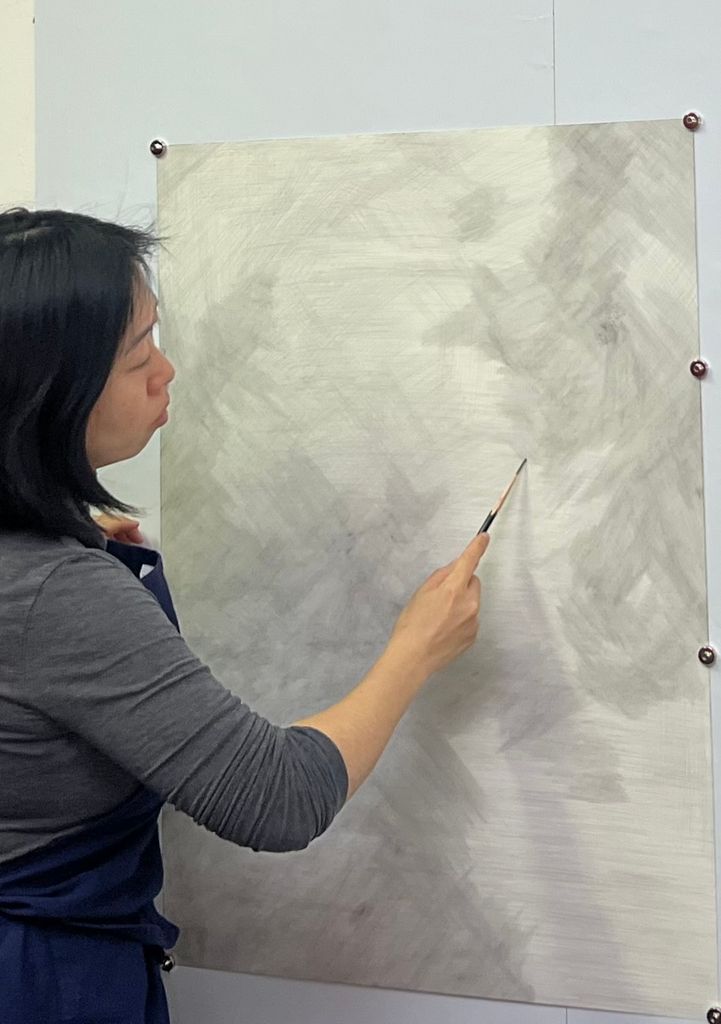
Hounyeh Kim
Growing up between South Korea and the United States, Hounyeh Kim became interested not only in cultural difference, but in why people exposed to similar social structures could still perceive, behave, and respond to the world in markedly different ways. This led to a question that has remained central to her practice: how is a self formed through the particular ways a body encounters, responds to, and is changed by its surroundings?
She first studied French literature, where this curiosity developed into a sustained interest in phenomenology, especially the writings of Maurice Merleau-Ponty. After moving into visual art, her research expanded toward enactivism and process philosophy. Rather than treating perception as something produced by a stable subject, she became increasingly interested in how perception, action, memory, habit, and bodily adaptation participate in the continual formation of the subject itself.
For more than a decade, she explored these questions through audience-participatory games, installation, sound, video, performance, and digital media. During this period, she searched for ways of making claims that could apply across different bodies and contexts. Gradually, however, she came to see that the pursuit of universality often came at the expense of precision. Her research became more rigorous once she accepted its limits. Instead of trying to speak for every body, she chose to investigate the only perceptual system she could observe continuously through time and activity: her own.
This realization led her back to drawing, but not as a retreat from the questions raised by her earlier work. Where participatory and multisensory formats had distributed her research across many bodies and contexts at once, drawing allowed her to narrow the field of observation to a single, continuous case. Working with hard graphite on paper over long periods, she developed a method that provides relatively stable material conditions while allowing complex bodily responses to unfold through repetition. Friction, sound, vibration, fatigue, attention, habit, and learned expectation interact throughout the process, producing continual adjustments that are only partly accessible to conscious awareness.
Her current long-term project, Principle of Operation, develops this investigation through sustained first-person artistic research. As the project has continued, the body performing the work has itself changed: individual drawings now take less time to complete, pressure has increased, movements have become faster and more forceful, and gestures that once felt risky have become part of the working process. These changes are not treated as proof of a general theory, but as concrete indications that repeated experience alters the patterns through which the body responds.
The project does not propose that one body represents all others. Instead, it asks how far one carefully observed case can be taken. By following how one body senses, acts, adapts, remembers, and reorganizes itself over time, Kim investigates the self not as a fixed interior essence, but as something continually formed through relations between body, experience, and world.
Artist statement
My practice begins with a question: how is a self formed? I do not approach the self as a fixed interior essence that exists before experience, but as something continually formed through the particular ways a body senses, responds, adjusts, and carries previous experience into the present.
Drawing gives me a sustained condition in which this process can unfold. I keep the basic action and material conditions relatively stable while allowing the drawing to develop through prolonged interaction between body and surface.
Every movement produces more than a visible line. Graphite against paper generates friction, vibration, sound, pressure, and resistance. As the surface changes, so do these sensations. The hand fatigues, attention fluctuates, and maintaining a consistent movement becomes increasingly difficult.
Most of these adjustments do not occur as explicit decisions. Touch, sound, vision, fatigue, habit, attention, and previous experience act simultaneously, often before they can be isolated or put into words. What appears visually as repetition is therefore never exact repetition. Each movement emerges from a body already shaped by what has happened before and alters the conditions of what follows.
Over time, these changing patterns of response become observable across the series. They appear in the time required to complete a drawing, the amount of pressure I apply, and the scale and boldness of individual gestures. In my drawing series Iterative Calibration, for example, working time per drawing has fallen by nearly half over eight months, while pressure has increased to the point of breaking pencil lead within a single work. These changes provide a concrete indication of how a body adapts to conditions it once approached with caution.
These bodily adjustments, rather than the image itself, are the primary material of the work. The finished drawing is not a predetermined goal but the material residue of a much longer process of sensing, responding, and recalibrating.
Hard graphite is fundamental to this process because its friction, sound, and vibration produce an unusually persistent sensory response in my body. I do not treat this response as representative of other bodies. My own body is simply the only perceptual system I can follow continuously across thousands of hours with direct, if partial, access to its sensations and changing thresholds.
Some parts of Principle of Operation introduce logging alongside drawing. These logs are not measurements of experience. They are retrospective abstractions: selections, categories, and numerical values imposed on experiences that are far more unstable and complex than those forms can contain.
The categories therefore reveal not only what I experienced, but what I chose to extract, name, and make visible from that experience. As the categories change, so does the framework through which I understand and present what has happened. That interpretation can in turn affect what I notice in later sessions.
For this reason, Principle of Operation is structured as sustained first-person research rather than as an attempt to objectively measure bodily states. Different formats preserve, reduce, interrupt, or reorganize different aspects of the same process. Drawings, sounds, moving images, logs, and written reflections each retain only partial traces.
The drawings do not depict the formation of a self, and the logs do not measure it. They are traces produced within situations I construct in order to remain with the question over time.
Principle of Operation is my attempt to stay with that ongoing formation as it unfolds.